Why FDA Infant Formula Rules Lag Behind Modern Science
Share
Table of Contents
Parents assume infant formula sold in the U.S. meets the highest standards of safety and nutrition. The truth is more complicated. The FDA’s regulations governing formula have not kept pace with modern science, leaving American families with products that often fall short compared to European and Australian options.
Why FDA Formula regulations are outdated
- Stagnant standards: The FDA’s nutrient requirements for infant formula haven’t undergone a comprehensive update in over 20 years.
The FDA is currently reviewing submissions to the Request for Information (RFI) on infant formula nutrient requirements that it issued in May 2025. This RFI is a part of the Make America Healthy Again (MAHA) Commission’s Operation Stork Speed, which is undertaking the first comprehensive review of infant formula nutrition standards since 1998.
The RFI sought public input on new science, potential contaminants (heavy metals, plasticizers), and innovation. The initiative aims to enhance formula safety and nutrition, allowing for changes to nutrient levels (like iron, fats) and adding new ones, moving towards international harmonization and addressing consumer demand for cleaner ingredients.
- Reactive enforcement: The Abbott recall in 2022 exposed how slow FDA was to act on whistleblower complaints and contamination risks.
The audit report conducted by the Inspector General of the U.S. Department of Health and Human Services, the parent organization of the FDA uncovered multiple deficiencies in policies and procedures that compromised the agency’s ability to safeguard the infant formula supply chain.
Delays in responding to whistleblower complaints, inadequate communication of consumer complaints, lack of timely mission-critical inspections, and insufficient recall authority all contributed to a delayed and ineffective response.
- Science gap: The FDA does not mandate certain nutrients (like DHA and ARA) that are required in the EU, despite strong evidence of their role in brain and eye development.
- Global misalignment: U.S. rules diverge from international benchmarks like Codex Alimentarius and European Food Safety Authority (EFSA), leaving American families with less rigorous protections.
Why differences in formula regulations exist
Read our US Baby formula regulation & safety study
The regulatory philosophy plays a large role in why these differences exist as the EU adopts a precautionary stance to its regulation that prioritizes minimizing potential risks, even with partial evidence.
On the other hand the US approach is much higher risk as it regulates based on demonstrated harm and post‑market controls to manage issues. In other words it is a much less stringent set of regulations and that is harm mitigation versus risk mitigation.
The structure of the EU has shaped the policy as it requires a more harmonized approach across member states, which has led to prescriptive, uniform standards, whereas the US is more commercially focused on innovation and access regardless of the product quality.
Read our US Baby formula safety study
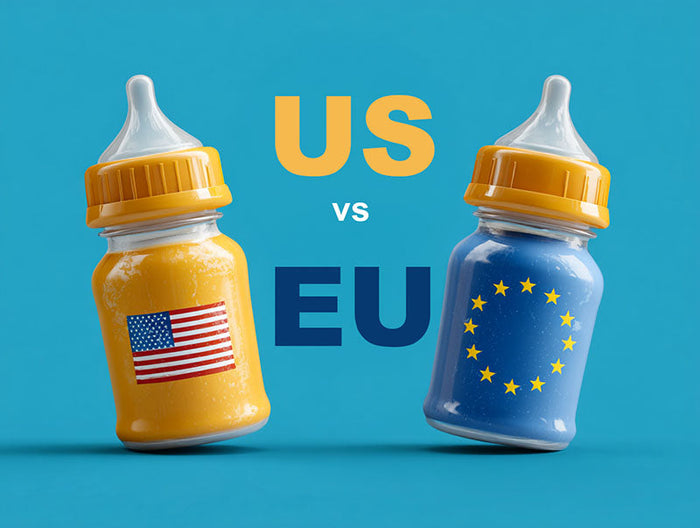
EU vs. US: Key Differences in Formula Regulation
|
Differences |
EU Approach (Risk Mitigation) |
US Approach (Cost-Benefit Assessment) |
|---|---|---|
|
Nutrient updates |
Regular revisions based on EFSA science |
Rare updates; last major review >20 years ago |
|
Labeling, claims, and transparency |
· Claims: Tight control; limited marketing claims; specific wording rules for nutrition and health claims. • Transparency: Clear ingredient origins, allergen statements, and preparation guidance; stricter organic labeling. |
· Claims: Broader marketing leeway; structure/function claims permitted with disclaimers. • Transparency: variability in claim rigor and prominence. |
|
Macronutrients and energy |
· Narrower allowable ranges; focus on whey/casein ratios approximating breast milk · Carbohydrates: Glucose, fructose, and sucrose are tightly restricted in infant formula. · Fats: Structured lipid profiles; limits on certain saturated and trans fats. |
· Protein: Broader ranges permitted if overall nutrient profile is adequate • Carbohydrates: More flexibility; sucrose may be present in some products. • Fats: Composition must meet energy and essential fatty acid needs; specific profiles less prescriptive. |
|
Micronutrients and fortification |
· Minimums/maximums: Detailed tables with tighter ranges; mandatory additions like DHA in infant formula. • Upper limits: Stricter caps to reduce over‑supplementation risk. |
· Required nutrients: Set minimums for key vitamins and minerals; upper limits less uniformly codified. • DHA/ARA: Not universally mandated; manufacturer discretion guided by safety/efficacy evidence. |
|
Additives/sugars |
Tight restrictions (e.g., sucrose banned in infant formula) |
More permissive; sucrose allowed |
|
Contaminant limits |
Lower thresholds, precautionary principle |
Higher thresholds, reactive enforcement |
|
Enforcement |
Proactive inspections, harmonized EU rules |
Slow response, fragmented oversight |
Why the differences in formula regulation matter for parents
Outdated nutrient ranges risk under or over supplementation, affecting infant growth and neurodevelopment. The narrower EU ranges and mandated DHA optimize neurodevelopment, whereas the US flexibility leads to large product ingredient quality variations that parents should evaluate carefully.
US labels may require more critical reading to separate claims from unsubstantiated benefits. The stricter EU claim controls reduce marketing noise and increase transparency.
Tighter EU contaminant limits and additive restrictions can reduce exposure to unwanted compounds.
EU limits on sucrose help avoid early preference for sweet flavors. Early exposure to sucrose in formula or foods can reinforce a preference for sweetness, shaping long-term dietary habits, making early flavor variety and reduced added sugars critical for healthy development.
The baby formula regulatory landscape in the US has quite rightly reduced consumer trust, which has resulted in parents increasingly seeking EU/Australian formulas because they reflect modern science and have stricter safety standards.
What Parents should know about outdated FDA Formula regulations
When it comes to infant formula, the gap between EU science‑driven standards and the FDA’s outdated, reactive approach is clear. European regulators regularly update nutrient requirements, mandate proven ingredients like DHA, and enforce stricter contaminant limits, all under the precautionary principle.
In contrast, the FDA relies on decades‑old rules, broad nutrient ranges, and enforcement that often follows crises rather than preventing them.
For parents, these differences directly shape what goes into your baby’s bottle. Choosing formulas aligned with modern science and higher safety standards means choosing confidence, transparency, and purity. That’s why GrowOrganicBaby.com is committed to bringing U.S. families access to premium European and Australian formulas, ensuring every child gets the healthiest start possible.

Rodney Hyde
International Formula Expert at Grow Organic Baby